


 English
 Español
 عربى
عربى
Synthetic vs Natural Mooring Lines: Which Is Better?
Content
- 1 The Short Answer: Synthetic Mooring Lines Win for Most Applications
- 2 What Makes a Mooring Line Perform Well
- 3 Natural Fiber Mooring Lines: Manila, Sisal, and Hemp
- 4 Types of Synthetic Mooring Lines and How They Differ
- 5 Direct Comparison: Synthetic vs Natural Mooring Lines
- 6 Mooring Line Construction: Twisted, Braided, and Double-Braided
- 7 Choosing the Right Synthetic Mooring Line for Your Situation
- 8 Safety Considerations: Snap-Back Zones and Line Inspection
- 9 The Cost Argument: Why Synthetic Lines Are Cheaper Over Time
- 10 Environmental Considerations: Synthetic Lines and Microplastics
- 11 Practical Recommendations by Vessel Type and Mooring Use
The Short Answer: Synthetic Mooring Lines Win for Most Applications
If you are deciding between synthetic and natural fiber mooring lines, the practical answer for the vast majority of marine applications today is clear: synthetic mooring lines outperform natural fiber alternatives in nearly every measurable category. They last longer, absorb more shock, resist rot and moisture damage, and maintain consistent tensile strength across a wide range of conditions. Natural fiber lines — traditionally made from manila, sisal, or hemp — still have niche uses, but they have been largely replaced in commercial, offshore, and even recreational mooring setups.
That said, "synthetic" is not a single material. Nylon, polyester, polypropylene, HMPE (high-modulus polyethylene), and various hybrid constructions each behave differently under load. Choosing the right mooring line means understanding not just synthetic versus natural, but which type of synthetic line suits your specific mooring situation — water depth, vessel weight, tidal range, weather exposure, and budget all factor in.
This article breaks down how these materials compare, where each performs best, and what real-world data says about longevity, safety, and cost-effectiveness.
What Makes a Mooring Line Perform Well
Before comparing materials, it helps to understand what properties actually matter in a mooring line. A line that looks strong on paper can fail catastrophically in the field if it lacks the right combination of characteristics. The key performance factors for any mooring line include:
- Breaking strength: The maximum load the line can withstand before failure. Usually expressed in kilonewtons (kN) or tonnes.
- Elongation / elasticity: How much the line stretches under load. Higher elongation absorbs shock; lower elongation transfers loads more directly.
- Creep resistance: Whether the line permanently elongates over time under sustained tension.
- UV and weather resistance: How well the line holds up under prolonged sun exposure, saltwater, and temperature cycles.
- Abrasion resistance: The line's ability to withstand chafing against cleats, fairleads, dock edges, and seabed surfaces.
- Weight in water: Whether the line floats or sinks, which affects handling, snap-back risk, and interaction with propellers.
- Resistance to biological degradation: How well it holds up against mold, bacteria, and marine organisms.
- Service life: How many years the line remains serviceable under typical operating conditions.
Natural fiber lines struggle on nearly all of these fronts when compared directly to synthetic alternatives. They absorb water, which increases weight and promotes rot. They degrade under UV exposure. They lose significant tensile strength when wet — manila lines, for example, can lose up to 30% of their dry breaking strength when soaked. None of that applies to well-selected synthetic mooring lines.
Natural Fiber Mooring Lines: Manila, Sisal, and Hemp
Natural fiber lines have been used in maritime applications for centuries. Manila — made from abaca plant fibers — was the dominant mooring and docking line material until synthetic alternatives became widely available in the mid-20th century. Sisal and hemp were also common, though manila was generally preferred for its higher strength and flexibility.
Where Natural Fiber Lines Still Get Used
Today, natural fiber mooring lines are rarely the first choice for functional marine use. Their main applications are:
- Historic vessel restorations and tall ships where authenticity is a priority
- Decorative and ceremonial uses in maritime environments
- Training exercises where the handling properties of natural rope are part of the curriculum
- Low-load, short-duration applications in sheltered, freshwater environments
The Core Weaknesses of Natural Fiber Lines
The problems with natural fiber mooring lines in any demanding environment are well documented:
- Moisture absorption: Natural fibers absorb water heavily, making lines significantly heavier and harder to handle when wet. Wet manila can weigh up to 40% more than dry.
- Rot and mildew: Stored wet, natural fiber lines begin to degrade within days. Prolonged exposure to salt water and humidity accelerates fiber breakdown significantly.
- Strength loss when wet: A dry manila line rated at 10,000 lbs breaking strength may only hold around 7,000 lbs when thoroughly wet — a 30% reduction that directly affects safety margins.
- Short service life: Even well-maintained manila mooring lines rarely last more than 2–3 years in active marine service before strength degradation becomes a safety concern.
- UV sensitivity: Sustained sunlight exposure causes fiber brittleness and accelerated breakdown, especially in tropical and subtropical climates.
Given these limitations, there is no practical argument for using natural fiber lines in a standard mooring setup when synthetic alternatives are available at comparable or lower cost over a full service lifecycle.
Types of Synthetic Mooring Lines and How They Differ
Synthetic mooring lines are not a single product category. The material, construction method, and diameter all dramatically affect performance. The four most common synthetic materials used in mooring lines are nylon, polyester, polypropylene, and HMPE (also sold under brand names like Dyneema and Spectra). Each has distinct strengths and tradeoffs.
Nylon Mooring Lines
Nylon is the most widely used synthetic mooring line material for small to medium-sized vessels. Its defining characteristic is high elongation — nylon lines typically stretch 15–25% before reaching breaking strength. This elasticity acts as a shock absorber, reducing peak loads on cleats, deck fittings, and the vessel's hull when surge, wave action, or wind gusts create sudden tension spikes.
Nylon is strong, relatively affordable, and handles well. The main drawbacks are that it absorbs some water (losing roughly 10–15% of its dry strength when wet) and has moderate UV resistance that requires attention over time. For marina berths, coastal moorings, and recreational vessels up to around 100 feet, nylon dock and mooring lines remain a practical, cost-effective standard.
Polyester Mooring Lines
Polyester is less elastic than nylon — typically elongating around 3–10% at working load — which makes it better suited to situations where load control and minimal line movement are priorities. It does not absorb water, maintains consistent strength wet or dry, and has excellent UV resistance. Polyester mooring lines also resist abrasion well, making them a good choice where chafing against dock structures is a concern.
The tradeoff is that polyester's lower elongation means it transfers more shock load to fittings and the vessel structure. In high-surge or high-swell environments, this can be a disadvantage compared to nylon. Polyester is widely used in commercial shipping, tug operations, and situations where precise control of line length and position matters.
Polypropylene Mooring Lines
Polypropylene is the lightest of the common synthetic mooring line materials and has the unique property of floating on water. This makes it useful in applications where keeping the line off the seabed matters — such as in areas with high boat traffic or where line-propeller entanglement is a risk.
However, polypropylene is significantly weaker than nylon or polyester for the same diameter, and it has poor UV resistance. Extended sun exposure causes polypropylene to become brittle and lose tensile strength rapidly. It also has a lower melting point, making it susceptible to heat damage from friction. Polypropylene is generally not recommended as a primary mooring line for long-term use in exposed marine environments, though it serves as a reasonable light-duty or temporary option.
HMPE / Dyneema Mooring Lines
High-modulus polyethylene (HMPE) represents the high-performance end of the synthetic mooring line spectrum. Dyneema SK75, for example, has a breaking strength roughly 15 times that of steel wire of the same weight, and it floats. HMPE lines have very low elongation (typically under 3%), which provides precise load control and minimal movement at the berth — a significant advantage for large commercial vessels and offshore mooring systems.
The primary concerns with HMPE mooring lines are snap-back risk and cost. Because they store very little energy under tension (due to low elasticity), when they fail they release that energy almost instantly, creating a dangerous snap-back zone. Proper personnel training and snap-back zone awareness are essential. HMPE lines also cost several times more than nylon or polyester per meter, though their extended service life (often 10 years or more in appropriate applications) can justify the investment in commercial contexts.
HMPE and similar high-performance synthetics are also subject to creep — slow permanent elongation under sustained load — which must be factored into long-term mooring system design, particularly for permanent or semi-permanent deepwater moorings.
Direct Comparison: Synthetic vs Natural Mooring Lines
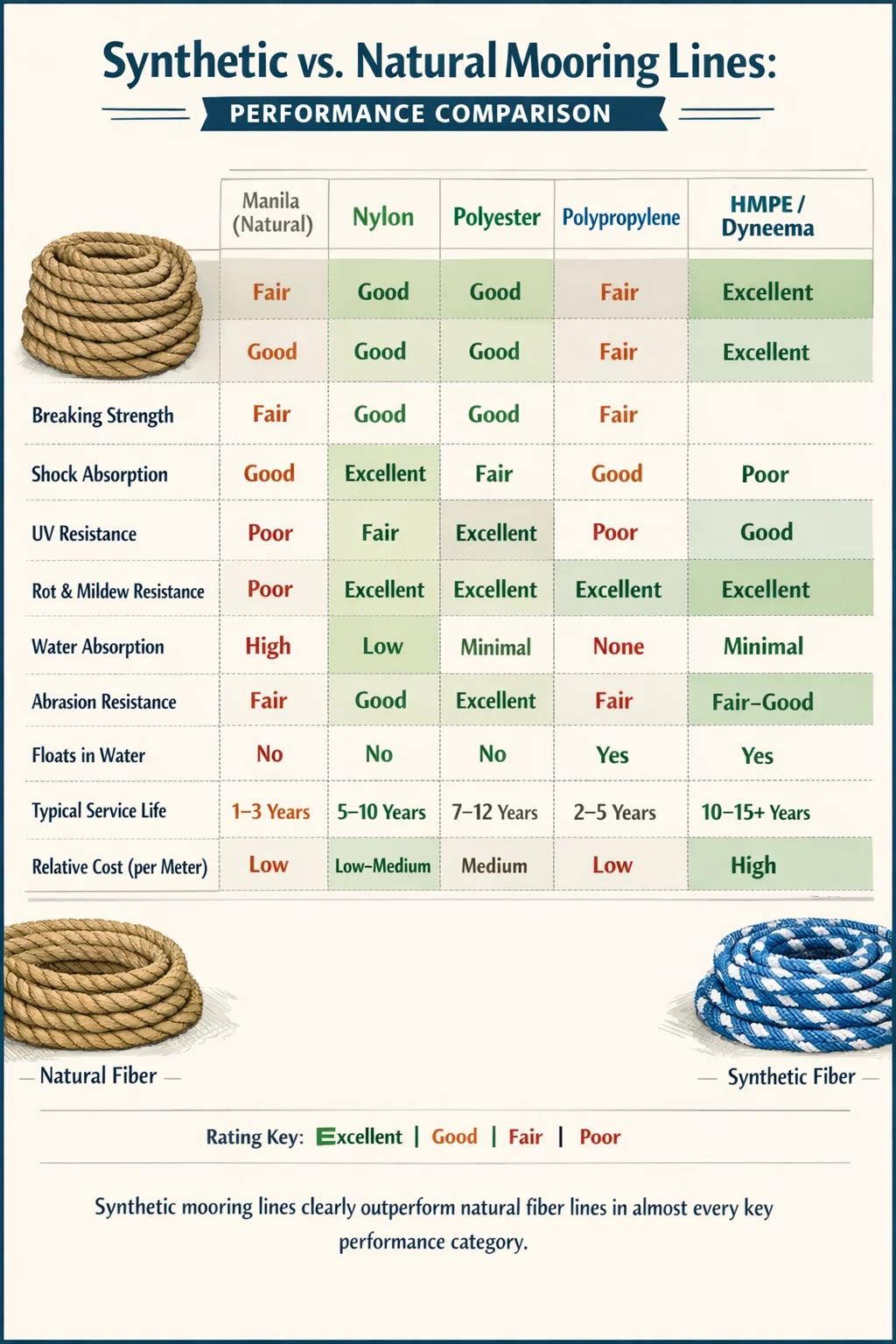
The table below compares the most important performance characteristics of natural fiber mooring lines against the main synthetic options across commonly evaluated criteria.
| Property | Manila (Natural) | Nylon | Polyester | Polypropylene | HMPE / Dyneema |
|---|---|---|---|---|---|
| Breaking Strength (relative) | Fair | Good | Good | Fair | Excellent |
| Shock Absorption | Good | Excellent | Fair | Good | Poor |
| UV Resistance | Poor | Fair | Excellent | Poor | Good |
| Rot / Mildew Resistance | Poor | Excellent | Excellent | Excellent | Excellent |
| Water Absorption | High | Low | Minimal | None | Minimal |
| Abrasion Resistance | Fair | Good | Excellent | Fair | Fair–Good |
| Floats in Water | No | No | No | Yes | Yes |
| Typical Service Life | 1–3 years | 5–10 years | 7–12 years | 2–5 years | 10–15+ years |
| Relative Cost (per meter) | Low | Low–Medium | Medium | Low | High |
The data above makes the case clearly: in terms of total value over a service lifecycle, synthetic mooring lines — particularly nylon and polyester — are significantly more cost-effective than natural fiber alternatives, despite sometimes having a higher upfront price. When you account for replacement frequency, handling difficulty, and the risk of strength loss at critical moments, natural fiber lines become the expensive option.
Mooring Line Construction: Twisted, Braided, and Double-Braided
The way a mooring line is constructed affects its handling, flexibility, strength retention at knots and splices, and resistance to abrasion — often as much as the material itself. The three primary constructions are:
Three-Strand Twisted
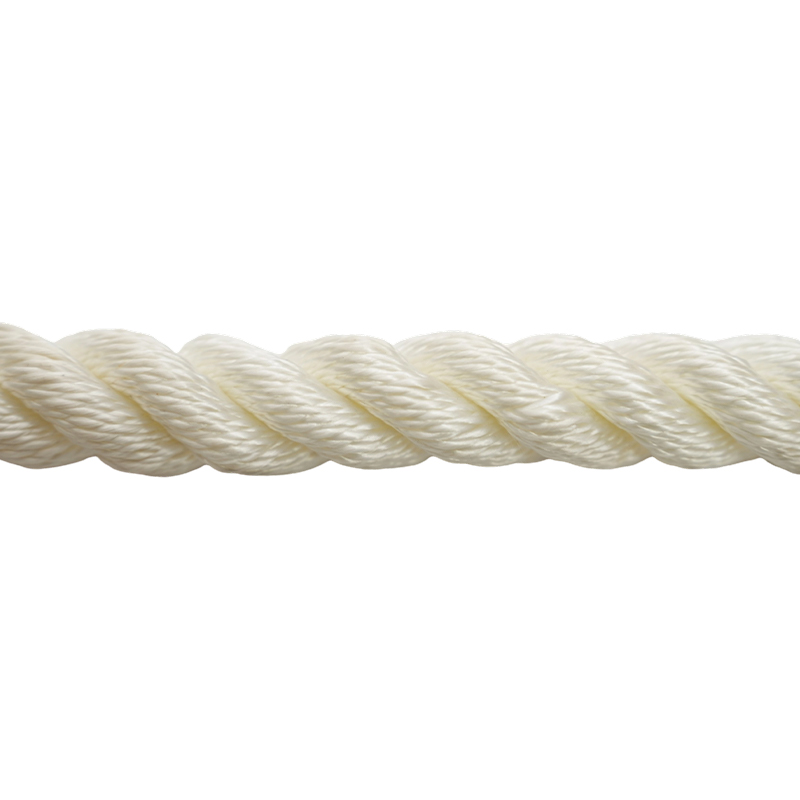
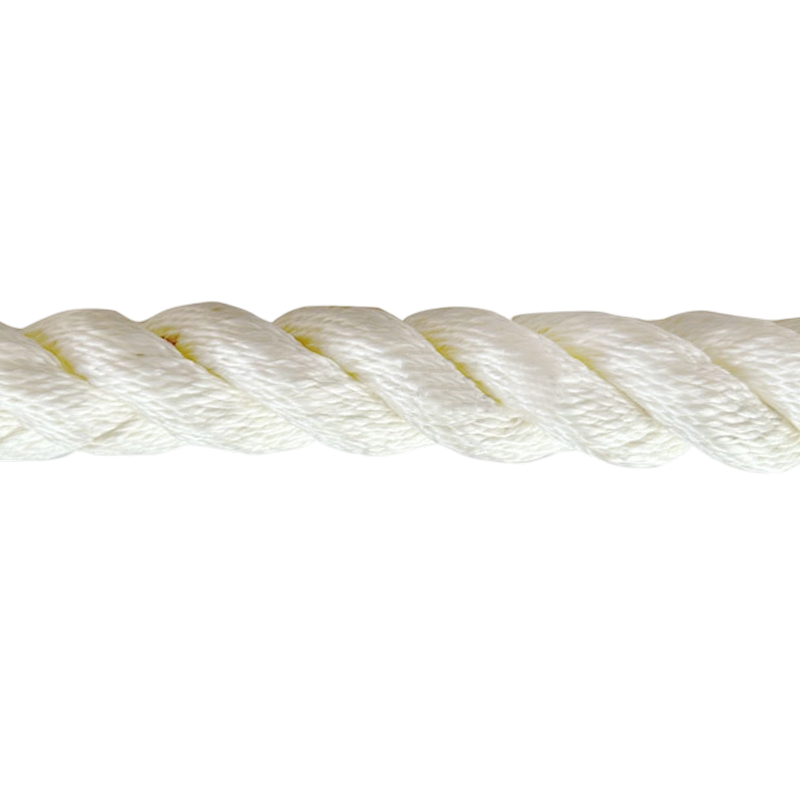
Three-strand twisted rope is the traditional construction for both natural and synthetic mooring lines. It is the easiest to inspect for internal damage, easy to splice, and relatively straightforward to manufacture. For nylon mooring lines, three-strand construction is still commonly used because it splices well and is cost-effective. It does tend to rotate under tension, which can cause uneven wear at contact points and lead to hockle (kinking) if improperly handled.
8-Strand and 12-Strand Braided
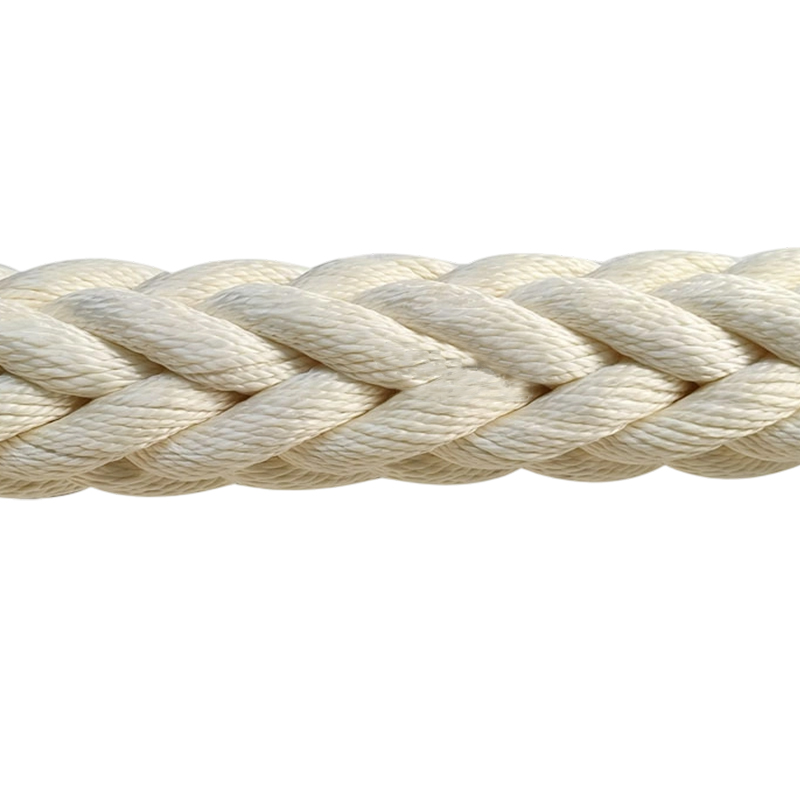
Braided constructions — particularly 8-strand and 12-strand — are common in larger synthetic mooring lines used in commercial and offshore applications. They are torque-neutral (do not rotate under load), handle more smoothly over winches and bitts, and distribute wear more evenly than twisted rope. 12-strand braids are standard in many port and harbor mooring applications using polyester or HMPE.
Double-Braided (Braid-on-Braid)
Double-braided mooring lines feature a braided core inside a braided outer cover, combining strength from both elements. This construction gives an excellent strength-to-weight ratio, good abrasion resistance, and comfortable handling. Double-braid nylon is a popular choice for recreational and semi-commercial dock lines because it handles well, splices cleanly, and provides good shock absorption. The outer cover also provides UV protection for the inner core fibers.
Choosing the Right Synthetic Mooring Line for Your Situation
Not all moorings are equal, and the best synthetic mooring line for a 30-foot sailboat at a sheltered marina berth is not the same as the best choice for a 300-meter LNG carrier at an exposed terminal. The following guidance helps match the right synthetic line type to common mooring scenarios.
Recreational Vessels at Marina Berths
For boats up to around 15 meters in length at standard marina berths, double-braid nylon is the standard recommendation. Its shock-absorbing properties protect the vessel and dock hardware from surge loads, it handles comfortably for everyday use, and it splices cleanly. Line diameter should be sized according to vessel displacement — a common rule of thumb is 1mm of line diameter for every 3 feet of boat length, though actual sizing should reference load tables from line manufacturers.
Vessels in High-Surge or High-Exposure Environments
Anchorages and marinas exposed to significant swell, wind chop, or vessel wash put higher dynamic loads on mooring lines. In these environments, the shock-absorbing properties of nylon become even more valuable. Some operators add dedicated nylon snubbers or spring lines to polyester or HMPE line arrangements specifically to restore some elasticity into an otherwise stiff mooring system.
Commercial Port and Harbor Mooring
Commercial vessels — tankers, bulk carriers, container ships, ferries — require mooring lines that can handle very high sustained loads with minimal stretch. Polyester 12-strand lines and HMPE lines are the primary options here. Polyester provides a good balance of strength, durability, and controlled elasticity. HMPE provides superior strength-to-weight and minimal elongation for precise position control. Many modern commercial mooring systems use polyester-HMPE composite lines that combine the low elongation of HMPE with the creep resistance and abrasion durability of a polyester outer jacket.
Offshore and Deepwater Mooring Systems
Floating production platforms, FPSOs, and similar offshore structures often use synthetic mooring lines as part of complex spread mooring or turret mooring arrangements. At water depths beyond 300–400 meters, the weight of steel wire or chain becomes a significant engineering constraint. Polyester mooring rope is the dominant choice for deepwater applications because it is nearly neutrally buoyant in seawater, which dramatically reduces the self-weight component of mooring line tension and allows effective mooring in depths exceeding 1,000 meters where steel wire is not practical.
In ultra-deepwater systems, HMPE is used where extremely high strength in a compact, lightweight package is required. These systems require careful engineering analysis of creep, fatigue, and long-term degradation under constant cyclic loading.
Safety Considerations: Snap-Back Zones and Line Inspection
Mooring line failures are one of the leading causes of serious injury and death in commercial port operations. The International Maritime Organization (IMO) and the Oil Companies International Marine Forum (OCIMF) have both published guidelines addressing mooring line safety, particularly around snap-back risk.
Understanding Snap-Back Risk
When a mooring line under tension fails suddenly, it releases stored elastic energy as kinetic energy, whipping back toward the vessel or the dock at extreme speed. The snap-back zone is the area at risk — roughly conical in shape, extending from the line's attachment points in the direction it would recoil. Personnel must never stand in the snap-back zone of a tensioned mooring line.
High-elongation lines like nylon store more elastic energy and have more severe snap-back potential than low-elongation lines like HMPE. However, even low-elongation HMPE lines store enough energy to be lethal when they fail. OCIMF guidelines and the MEG4 (Mooring Equipment Guidelines, 4th edition) provide detailed snap-back zone diagrams and operational guidance that should be standard knowledge for anyone working around mooring operations.
Inspection and Retirement Criteria
Synthetic mooring lines do not visibly announce their internal deterioration the way natural fiber lines do (natural fiber lines become obviously discolored, smell of rot, and show surface fiber breakdown). Synthetic lines can look acceptable on the outside while being significantly degraded internally from UV exposure, fatigue cycling, heat damage, or chemical contamination.
Key inspection points for synthetic mooring lines include:
- Surface abrasion: Excessive fuzzing or cuts in the outer cover indicate reduced cross-section and increased failure risk.
- Stiffness changes: A line that has become unusually stiff may have heat-damaged or chemically altered fibers.
- Discoloration: Brown or yellow staining, particularly on HMPE lines, can indicate UV degradation or chemical contamination.
- Core integrity (double-braid lines): Open the braid cover at intervals to check whether the core is intact and undamaged.
- End fittings and splices: Check that eye splices, thimbles, and any swaged fittings remain tight and undistorted.
OCIMF's MEG4 recommends that mooring lines in commercial service be retired based on a combination of age and condition assessments, with detailed records kept for each line. For recreational mooring lines, a practical rule is inspection before each season and replacement when visible damage is found or after 5–7 years for nylon and 8–12 years for polyester, assuming normal use and storage.
The Cost Argument: Why Synthetic Lines Are Cheaper Over Time
One of the most common defenses of natural fiber mooring lines is their low upfront cost. Manila rope is cheap per meter, and for budget-conscious operators this can be appealing. However, the lifecycle cost picture reverses this argument decisively.
Consider a basic example: a marina berth requiring four mooring lines of 15 meters each.
- Manila lines at a typical price might cost around €3–4 per meter, needing replacement every 2 years. Over a 10-year period, that is approximately 5 replacement sets — a total cost of around €900–1,200 for the four lines, not including labor and the disposal of degraded rope.
- Quality double-braid nylon lines at €6–8 per meter, lasting 7–10 years, require 1–2 replacements over the same 10-year period — a total cost of roughly €360–960 for the same four lines.
Even in the worst-case scenario for nylon, the 10-year costs are comparable. In realistic conditions — where nylon lines often reach 8–10 years with proper care while manila rarely exceeds 2 — synthetic lines are the more economical choice by a significant margin. Add in the safety benefits and reduced handling difficulty, and there is no meaningful economic argument for natural fiber lines in active marine use.
Environmental Considerations: Synthetic Lines and Microplastics
One area where natural fiber mooring lines have a legitimate advantage is environmental impact. Synthetic polymer fibers, when they abrade or degrade, shed microplastics into the marine environment. This is increasingly recognized as an ecological concern in port and harbor environments where mooring lines are in constant use.
Manila and other natural fiber lines biodegrade when they enter the ocean, though the process is not always clean or fast. The tradeoff involves comparing localized microplastic contamination from synthetics against the more rapid strength degradation and replacement frequency of natural fibers (which also generate waste through frequent disposal).
Research into bio-based synthetic fibers — materials like bio-polyester or hemp-reinforced composites — is ongoing, but none have achieved the performance levels of conventional synthetics at commercial scale. For now, the practical recommendation remains to use high-quality synthetic lines, maintain them well to extend service life, and dispose of retired lines responsibly through rope recycling programs where available. Some manufacturers, including DSM (producers of Dyneema), have introduced take-back and recycling initiatives for end-of-life rope.
Practical Recommendations by Vessel Type and Mooring Use
The following recommendations summarize the most practical synthetic mooring line choices for common applications, based on performance data, industry standards, and real-world operational experience.
- Recreational sailboats and motorboats (up to 15m): Double-braid nylon dock and mooring lines. Prioritize shock absorption and ease of handling. Replace when abrasion is visible or after 5–7 years.
- Larger recreational vessels and charter boats (15–30m): Double-braid nylon or polyester, depending on whether shock absorption or low-stretch load control is the priority. Heavier displacement vessels benefit from larger diameter polyester spring lines to limit movement at berth.
- Commercial ferries and coastal cargo vessels: 12-strand polyester as the primary choice for durability, UV resistance, and consistent wet/dry performance. HMPE eye splices or tails can be added where reduced weight at the working end is beneficial.
- Large commercial vessels (tankers, bulk carriers, container ships): OCIMF-compliant polyester or HMPE 12-strand lines, sized per the vessel's mooring equipment guidelines and berth requirements. Composite polyester/HMPE lines are increasingly standard for new builds.
- Offshore structures and deepwater moorings: Polyester for water depths between 300–2,000 meters. HMPE for ultra-deepwater applications or where weight and diameter are the primary constraints. Engineering analysis by a specialist mooring contractor is essential.
- Temporary or light-duty applications: Polypropylene acceptable for short-duration, low-load use — but replace frequently and never leave in direct sunlight for extended periods.
In every category, natural fiber lines are absent from the practical recommendation list. The performance gap is simply too significant for them to compete in any functional marine mooring application where safety, longevity, and reliable load-bearing capacity are requirements.
PREV:Polyester Rope: Complete Guide to Types, Strength & Best Uses
NEXT:Common Causes of Mooring Line Failure Explained
NEXT:Common Causes of Mooring Line Failure Explained
Related Products
-
 View More
3-Strand Polypropylene Mono-filament Mooring Rope / Line
-
 View More
3-Strand Polypropylene Multi-Filament Hawser Mooring Rope / Line
-
 View More
8-Strand Polypropylene Mono-filament Hawser Mooring Rope / Line
-
 View More
8-Strand Polypropylene Multi-filament Mooring Rope / Line
-
 View More
12-Strand Polypropylene Multi-filament Hawser Mooring Rope / Line
-
 View More
Polypropylene Multi-filament Double Braided Hawser Mooring Rope / Line
-
 View More
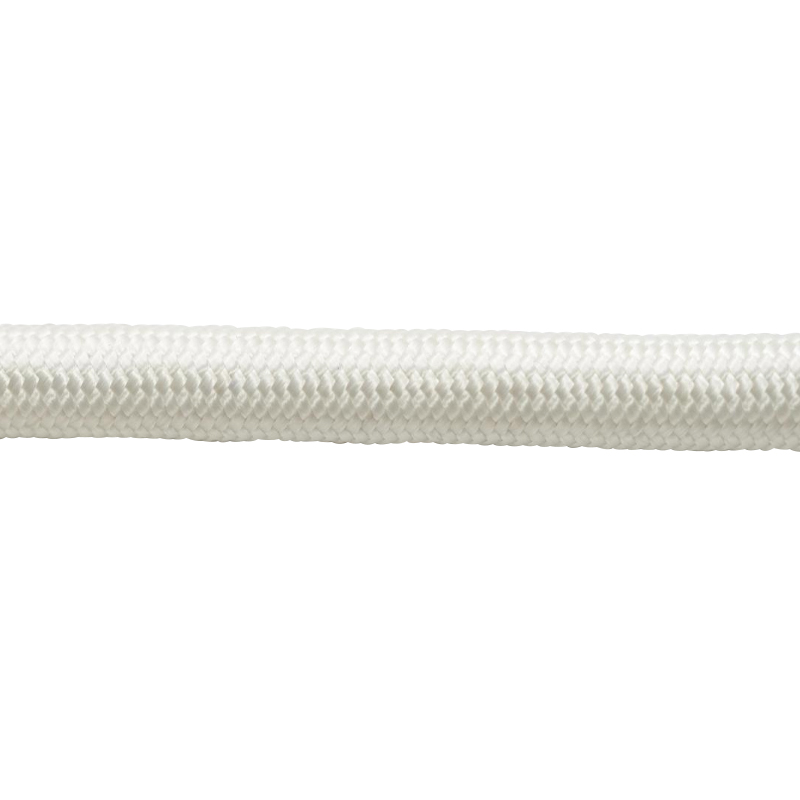
Polypropylene Multi-filament Reduced Recoil Mooring Rope / Line
-
 View More
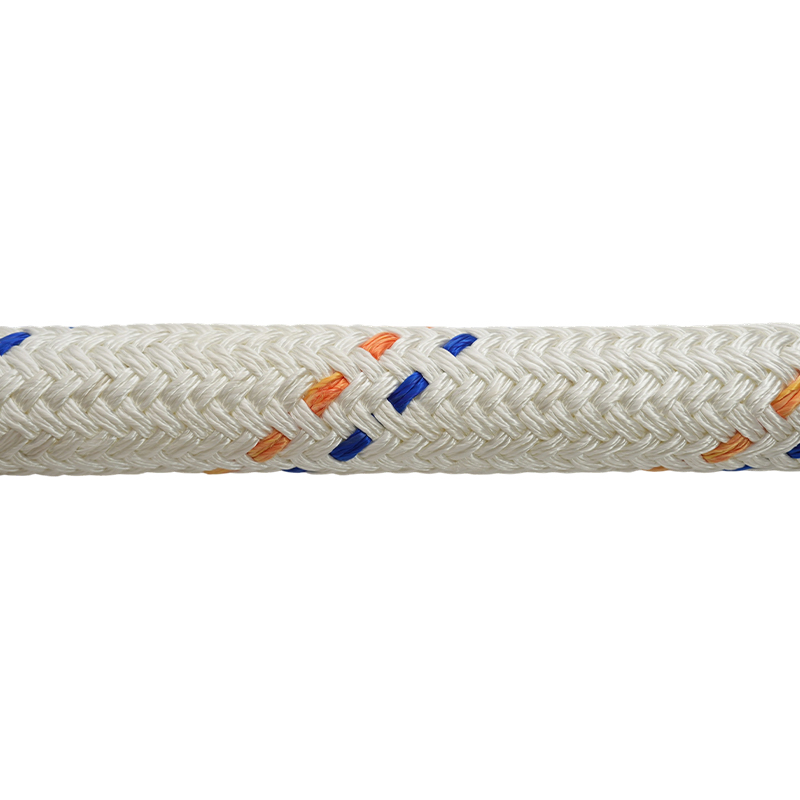
Polypropylene Multi-filament Mooring Tail
-
 View More
3-Strand Polyester Mooring Rope / Line
-
 View More
8-Strand Polyester Hawser Mooring Rope / Line
-
 View More
12-Strand Polyester Mooring Rope / Line,Hawser
-
 View More
Polyester Double Braided Hawser Mooring Rope / Line